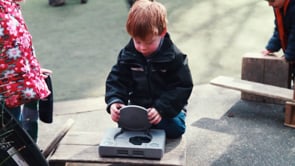
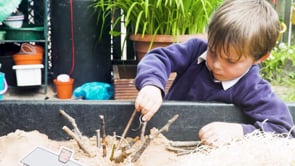
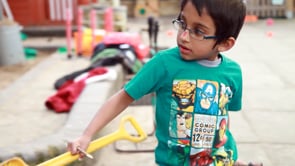
Here we see three year old, Seb, playing at home and at his nursery, with friends and adults. We look at how, through his play experiences, he is developing personally, socially and emotionally.
Good for looking at
- Learning through play
- Personal, social and emotional development
- Development of three year old
- Play with friends
- Play with parents
- Play in a nursery setting
Full chapter contents
- At playgroup playing with friend (2.5 year old girl) – using good language and non verbal communication to encourage her to play – 3 years 4 months
- Pretend playing with mum’s friend – talking about sharing – 3 years 3 months
- Playing at builders with friend (4 years) in garden – talking about helping each other – 3 years 10 months
- Playing at bakers in the playgroup – coping with being dominated by – 4 year old girl 3 years 4 months
- Playing in garden with friend – argument about toy – 3 years 11 months
- In park with mum – playing at police men, mum is villain – 4 years
- At playgroup with playgroup workers – feeling safe and valued by adults – 3 years 8 months
Early attachment and relationships
A child’s early attachment and relationship experiences are vital for their physical and emotional well-being, building their brains and allowing them to develop the skills to regulate and control their emotions and actions. A child who knows they are loved and valued feels safe enough to take risks – to branch out and explore the world, knowing that they have a secure base of relationships to return to.
Building emotional resilience
They are also building emotional resilience, helping them to cope with future setbacks and disappointments, because they have a strong sense of identity and self worth. Seb shows us his determination to master new tasks but he is also able to ask for and accept help when he needs it.
When our own emotional resilience is strong, we are better able to negotiate and compromise and to empathise with others. We are less likely to feel the need to behave in bullying ways or to allow ourselves to be bullied or victimised. We see Seb negotiating and compromising with his playmates, asserting himself when necessary but also knowing when to step back and avoid confrontation.
The ability to empathise
He also shows interest in the well-being of others and is able to take steps to help someone else. The ability to empathise, to see things from another’s point of view, to recognise one’s own needs and those of others is essential if children are to grow up being able to recognise and challenge inequality and bias, on behalf of themselves and others.
A sense of well–being
A sense of well–being is also essential for learning- it is really difficult to take on new information when we are stressed. We see Seb exploring the world, building his skills and learning new things confidently in the relaxed environment of his home and in the comfortable, nurturing environment of his playgroup, with adults he knows and who know him well enough to respond sensitively to his needs. He can even handle ‘scary’ ideas and notions in his play scenarios with his mum, allowing him to explore difficult subjects and potential threat in ways that are safe and ultimately re- assuring.
Interests and motivations
In environments that support rich play experiences, children are able to follow their own interests and motivations to a personal conclusion and at a level appropriate to their stage of development, regardless of their age. This in turn encourages the development of positive learning dispositions such as curiosity, reflection, perseverance and responsibility – so important for learning throughout life.
- From Birth to One – The year of opportunity by Maria Robinson (Open University Press)
- Why Love Matters – How affection shapes a baby’s brain by Sue Gerhardt (Brunner-Routledge)
- Assessment in Early Childhood Settings by Margaret Carr (Paul Chapman)
- Young Children’s Personal Social and Emotional Development by Marion Dowling, Paul Chapman Publishing 2000